
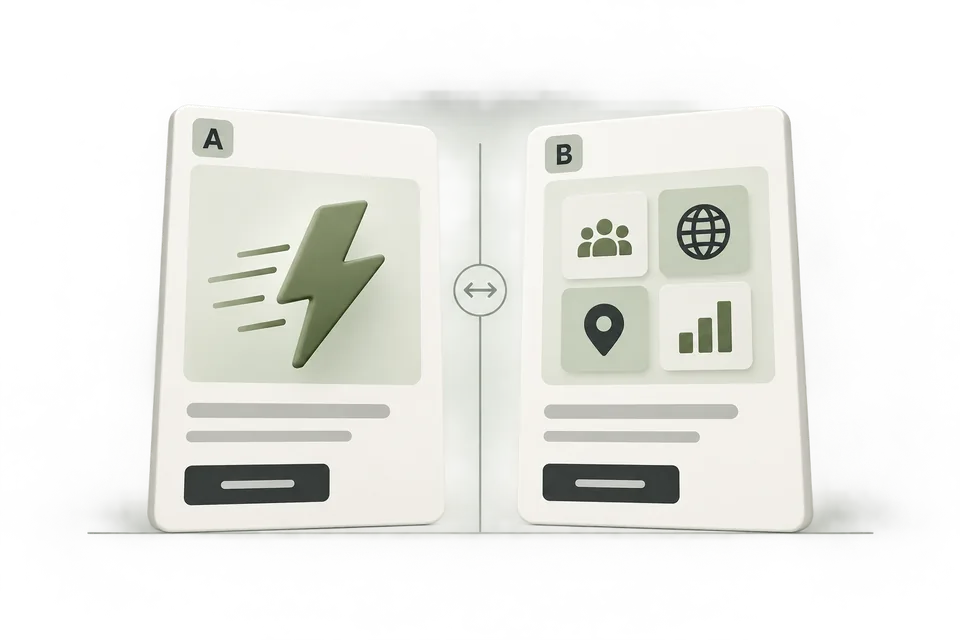
A creative test is useful when its result changes a decision. “Try more ads” is not a hypothesis. “Buyers respond more strongly to a faster setup than to a broader feature set” gives the team something specific to compare.
Choose the reason to buy
Start with a customer problem and two credible ways to explain the offer. For bookkeeping software, one angle could emphasize getting invoices out quickly; another could emphasize knowing which payments need attention. Both claims must be supported by the product.
Write the hypothesis in the creative brief before drafting variants. This reduces the temptation to explain a result after the fact with whichever feature happened to appear in the winning ad.
Control what you can
Keep the offer, destination, geography, and evaluation window consistent when the aim is to compare messaging. If you deliberately test a different landing page, call it a message-and-page test rather than attributing the result only to the headline.
Use clear version names and preserve the exact copy and asset. An ad that is edited halfway through a reporting period is not the same treatment throughout the period. Record the edit date and avoid combining incompatible versions.
| Test element | Example |
|---|---|
| Hypothesis | Setup speed matters more than feature breadth |
| Variant A | A clear speed benefit with supporting evidence |
| Variant B | A clear coverage benefit with supporting evidence |
| Primary outcome | Qualified trial activation |
| Guardrail | No unsupported claims; working destination |
| Decision | Keep, revise, or stop after the predefined review |
Make variants visibly different in meaning
A punctuation change or a synonym swap rarely represents a distinct customer proposition. Focus the limited review time on variants that change the reason to act. Use the description to support the headline rather than introducing a second unrelated promise.
Preview the asset at a small size and check the destination on mobile. A technically valid creative can still be difficult to read or inconsistent with the page it opens. Correct those issues before spending to test the message.
Plan the evaluation before launch
Choose a primary outcome and a maximum test budget. Decide how you will handle insufficient delivery or an incomplete conversion sample. There is no universal number of clicks that makes every creative comparison conclusive.
Avoid repeatedly declaring a winner whenever a small lead changes. Review at the planned checkpoints, inspect customer quality, and acknowledge uncertainty when outcomes are sparse. A directional result can justify another test without becoming a public benchmark.
Save what the next test should learn
Keep the hypothesis, variants, dates, spend, outcomes, and limitations together. If the speed message performs better, the next question may concern which proof supports that benefit or which buying situation values it most.
Brand context saved through your connected assistant and Advarde’s campaign drafts help preserve approved inputs. They do not turn a weak hypothesis into an informative experiment. The brief and the review record remain essential.
Sources and verification
Platform details checked on September 11, 2026. Your account may expose a different set of features. Examples are illustrative unless a dataset is explicitly supplied.