
Competitor research can reveal how a market describes a problem, presents evidence, and asks a buyer to act. It cannot establish a competitor’s spend, conversion rate, or profit merely from seeing an ad or landing page. Keep observations and interpretations separate.
Collect the page and the context
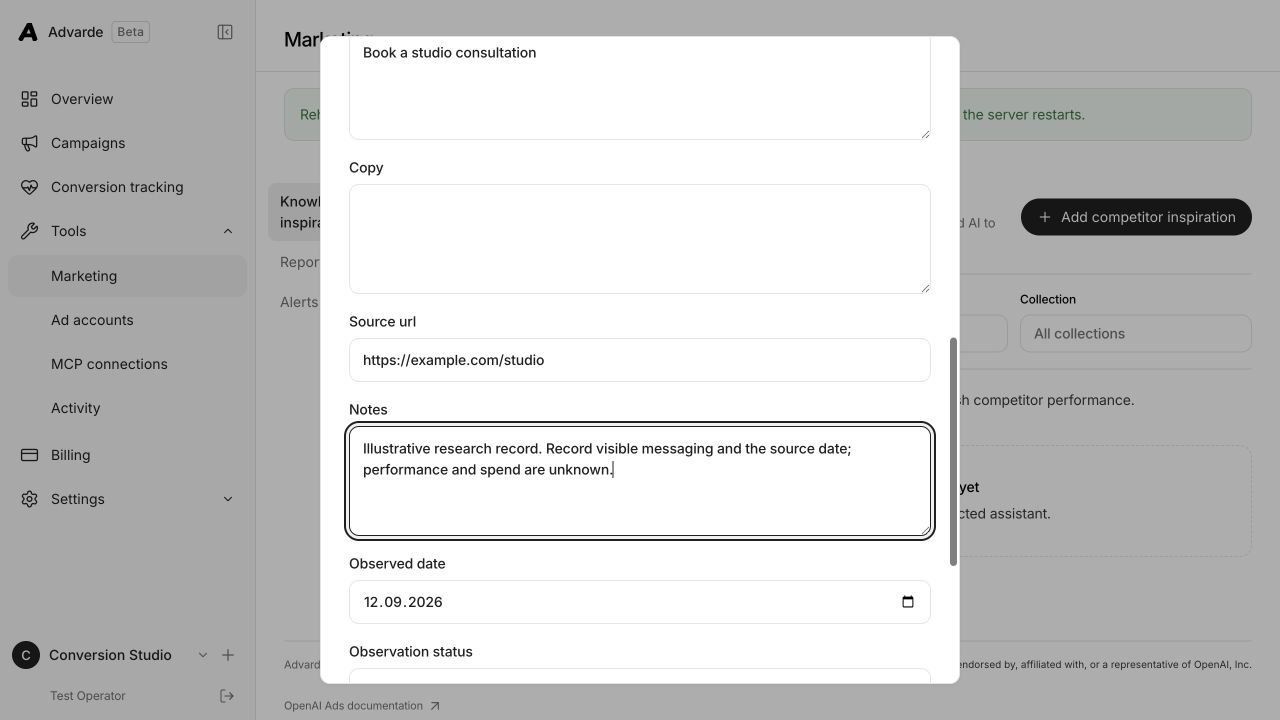
Save the public URL, observation date, offer, main claim, proof, and call to action. If you observe an ad, record the surface and context in which you saw it. A screenshot without a date or source is difficult to interpret later.
Use screenshots to document a visible feature, not to imply access to an advertiser’s private results. Respect the difference between a public product page, an actual ad observation, and a tool’s modeled estimate.
Build a messaging comparison
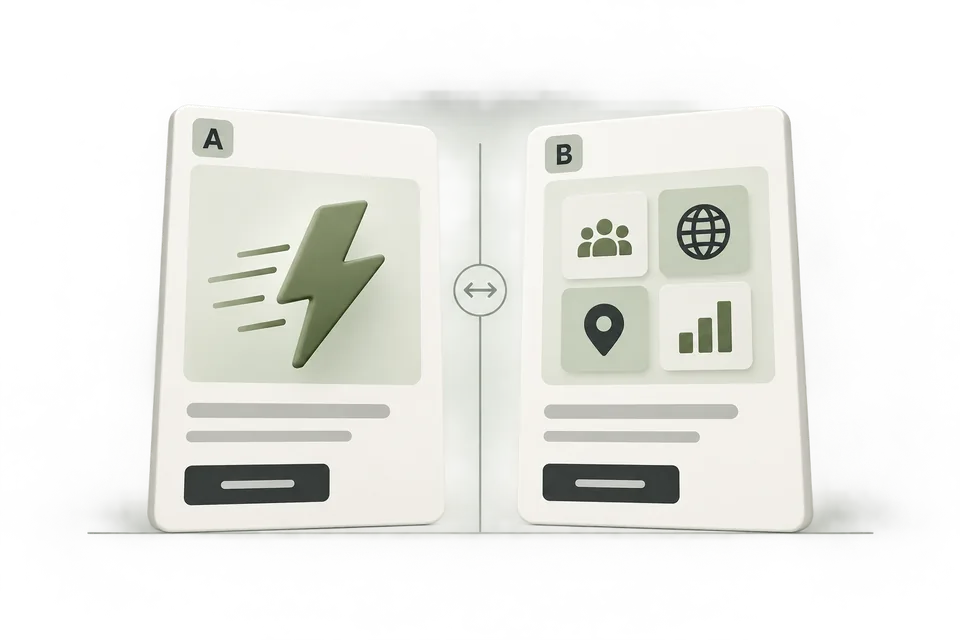
Compare the customer problem each competitor addresses, the reason to believe the claim, and the action requested. Look for questions left unanswered: prerequisites, implementation effort, account ownership, or the exact next step after signup.
Those gaps can inform original content. A clear setup guide or honest product screenshot may answer a buyer’s question more effectively than repeating a competitor’s headline with your brand substituted.
| Observation | Interpretation to test |
|---|---|
| Most pages emphasize launch speed | Buyers may need clearer review and approval information |
| Few pages show the actual interface | A documented workflow may reduce uncertainty |
| Claims lack sample definitions | A transparent method may be useful |
| Generic calls to action | A relevant tool or template may serve the reader better |
Be precise about monitoring
Advarde’s supporting tools can monitor explicitly supplied public pages and save meaningful text or literal-phrase changes. This is not a global ChatGPT ad library and does not discover every ad a competitor runs. Dynamic content can also be absent from a public-page read.
Treat a failed read as an unknown observation, not proof that the competitor stopped operating or removed an offer. Keep the last successful observation and investigate blocked or unavailable responses separately.
Turn a finding into an original hypothesis
If several competitors emphasize a feature, ask what customer need it addresses and whether your product supports a distinct answer. Use your own screenshots, examples, and factual claims. Do not copy a competitor’s prose or imply that its evidence applies to your business.
For a creative test, write the proposed customer reason to buy and how the result would change your next decision. Competitor visibility is a source of ideas, not proof that a message is effective.
Keep a traceable research record
Record the source, date, factual observation, interpretation, and proposed action in separate fields. Review the source again before publishing a comparison because pricing and availability can change.
If you publish results, disclose whether the product was tested hands-on or assessed only from public material. Unknown capabilities should remain unknown until verified.