

oCPC connects bidding with a conversion objective, but it does not turn every click into a sale or make payment conditional on a completed purchase. Evaluate the campaign using both its billing basis and the quality of the conversion signal.
Separate optimization from billing
OpenAI describes conversion-optimized campaigns as optimizing toward conversions while billing for valid clicks. That distinction matters when estimating cash outlay: the campaign can incur spend even during a period with no attributed conversions.
Use CPC to describe click cost and CPA or cost per qualified lead to describe the observed business result. If a report uses “CPA” to name a setting or objective, spell out whether it means a bid control, a target, or a calculated outcome.
Choose a conversion worth optimizing toward
A primary event should represent a meaningful completed action and occur reliably in your measurement implementation. A convenient page view can generate more observations than a qualified lead, but it may reward behavior that does not create business value.
For SaaS, separate registration, trial activation, and paid subscription. For lead generation, separate accepted forms from qualified opportunities. If you choose an earlier event because the final outcome is sparse or delayed, state that choice in the test plan and evaluate downstream quality separately.
Check account and creation-path support
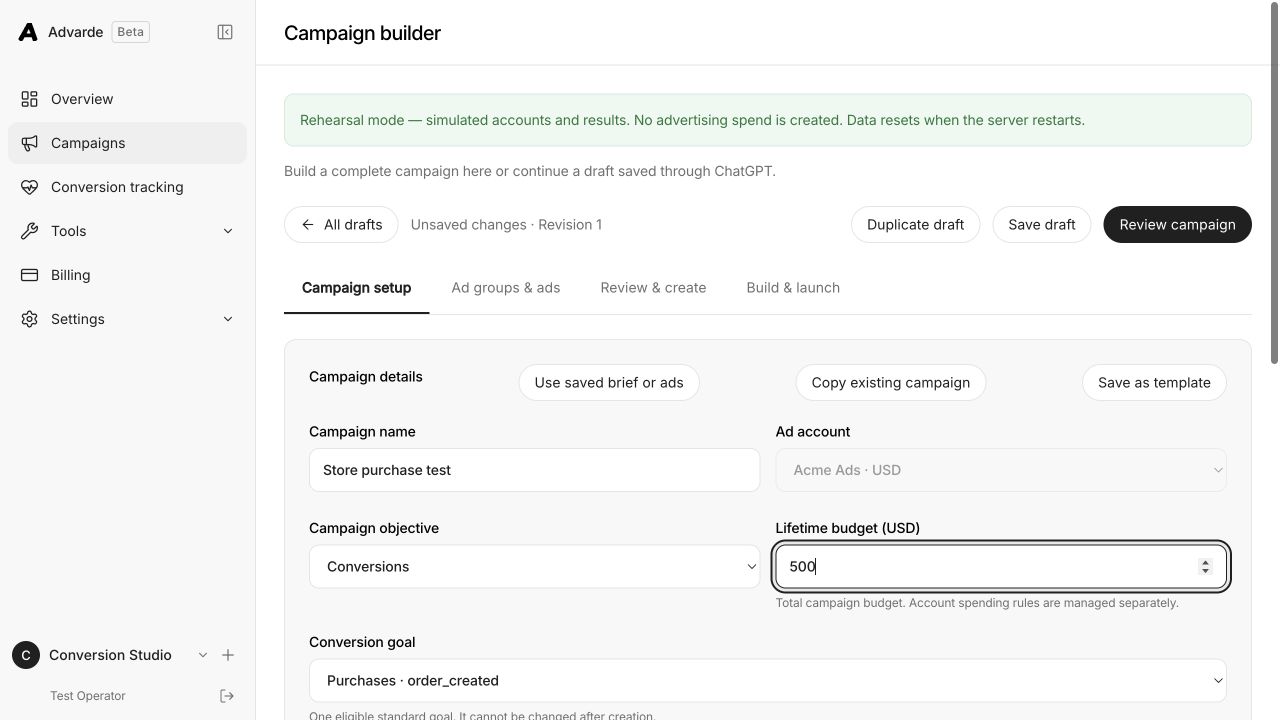
Availability can differ between Ads Manager, individual advertiser API operations, and the limited-preview bulk creation path. Advarde’s workbook compiler reports unsupported conversion creation cases rather than silently substituting a click objective.
Inspect the current account’s supported configuration and review the prepared campaign. Do not infer support merely because the spreadsheet accepts the word “conversions.” A locally valid business plan may still require a different supported submission path.
Model a range of results
Suppose 400 clicks cost $800. With eight qualified leads, cost per qualified lead is $100. With four qualified leads, it is $200. Both cases have the same $2 CPC. This simple example shows why a click-based price alone cannot establish the economics of conversion optimization.
Use your close rate and customer contribution to set the business threshold. Keep the expected event volume, maximum test spend, and evaluation date visible. Avoid declaring a winner from a small number of conversions whose quality has not yet been checked.
Review changes without disrupting interpretation
Mark changes to the primary event, destination, offer, or tracking implementation. Those changes can alter the meaning of the result even if the campaign name stays the same. Compare periods only when their definitions are compatible.
Keep measurement diagnostics and campaign results together in the report. If a tracking deployment changed midway through the test, identify the affected period before attributing the performance movement to bidding.
Sources and verification
Platform details checked on September 11, 2026. Your account may expose a different set of features. Examples are illustrative unless a dataset is explicitly supplied.