There is no single ChatGPT Ads cost that tells you whether the channel will work for your business. Separate the platform’s billing basis from your commercial outcome: paying for a click is different from acquiring a customer.
Use account-specific bids and actual spend to describe delivery. Use conversion quality and contribution to decide whether that delivery is affordable. The examples below are planning arithmetic, not market benchmarks. Published platform billing models and the USD daily-budget minimum are summarized in the ChatGPT ads guide.
Separate CPM, CPC, and acquisition cost
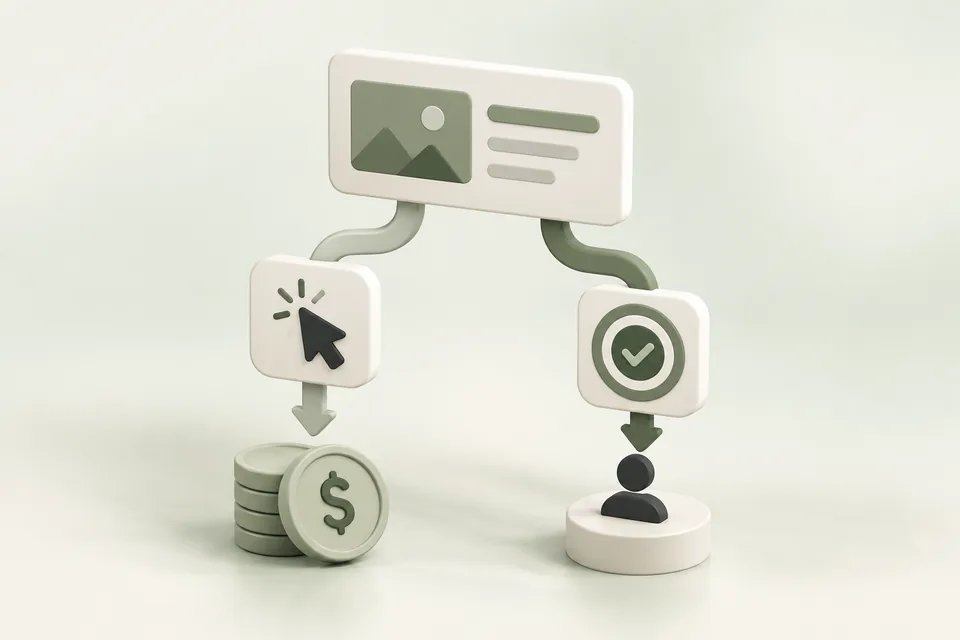
CPM expresses spend per thousand impressions. CPC expresses spend per click. Cost per acquisition divides spend by the business outcomes you choose to count. A campaign can optimize toward conversions while its billing basis remains clicks; the objective’s name alone does not tell you what appears on the bill.
In particular, OpenAI’s conversion-optimized campaign documentation describes oCPC as conversion optimization with click-based billing. Do not interpret a conversion objective as a guarantee that you pay only for completed purchases.
| Metric | Calculation | What it leaves out |
|---|---|---|
| CPM | Spend ÷ impressions × 1,000 | Whether anyone visits or buys |
| CPC | Spend ÷ clicks | Whether visitors become customers |
| Cost per qualified lead | Spend ÷ qualified leads | Whether those leads close |
| Customer acquisition cost | Acquisition costs ÷ new customers | Future retention unless explicitly modeled |
Work backward from customer contribution
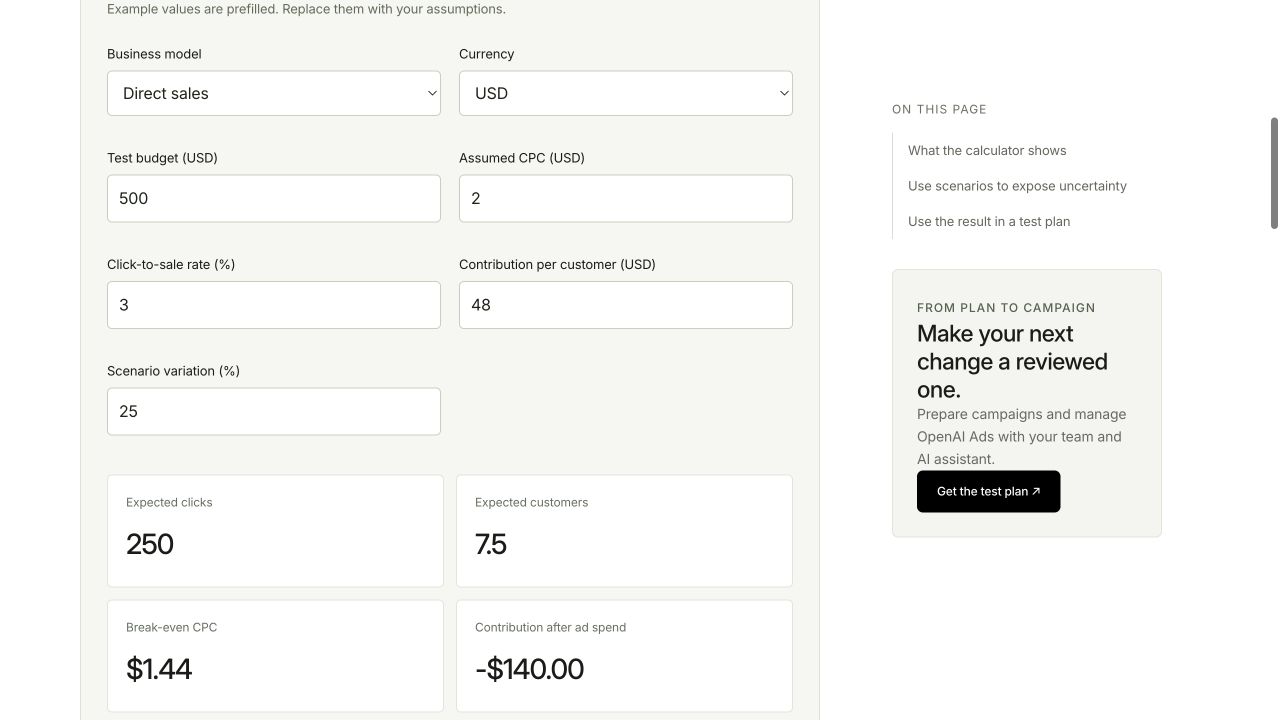
Suppose a first order brings $120 in revenue and $48 remains after product, fulfillment, and payment costs. If 3% of paid clicks become orders, the break-even CPC is $48 × 0.03 = $1.44 before agency fees and other acquisition overhead. Spending above that figure requires either better conversion performance or a justified contribution estimate beyond the first order.
For leads, include the close rate. If a won customer contributes $800 and 10% of qualified leads become customers, a qualified lead is worth $80 before other acquisition costs. With a 4% click-to-qualified-lead rate, the corresponding break-even CPC is $3.20. Do not mix a raw form-submission rate with a qualified-lead close rate.
Choose a test budget that matches the question
At an assumed $2 CPC, a $500 test buys approximately 250 clicks if that CPC is realized. At an assumed 2% conversion rate, the expectation is five conversions. That expectation is not a promise of five events and is too small to establish a precise long-term rate.
Decide whether the first budget is intended to check delivery, validate measurement, compare messages, or estimate economics. Those are different tests. A short technical check should not be sold internally as proof of scalable acquisition.
Account for costs outside media
Add creative production, landing-page work, management fees, software, and sales follow-up to the business case. Track these separately from the platform spend so your reports can answer both “what did traffic cost?” and “what did customer acquisition cost?”
Use a downside, base, and upside scenario in the budget calculator. Change the conversion assumption as well as CPC. A plan that works only with a low CPC and an optimistic close rate should be treated as a fragile hypothesis, not a budget commitment.
Use real delivery to update the model
After launch, compare actual clicks and spend with your assumed CPC. Then inspect the conversion flow and customer quality before changing the assumed conversion rate. Reporting delays and incomplete follow-up can make a recent cohort appear worse than a mature one.
Keep the initial model and the updated model side by side. Record the date, sample size, and event definition for each update. That creates a useful decision record instead of moving the target every time a new result appears.
Sources and verification
Platform details checked on September 11, 2026. Your account may expose a different set of features. Examples are illustrative unless a dataset is explicitly supplied.