

The agency-versus-in-house decision is mainly about who owns the work and who can do it reliably. Buying software does not remove the need for a clear offer, working measurement, creative review, and a person accountable for spending.
List the work before comparing fees
Include account setup, conversion implementation, campaign planning, copy and image production, landing-page changes, approvals, monitoring, and business-outcome reporting. A low management fee can still leave substantial implementation work with your team.
Assign an owner to each task. If nobody can publish website changes, an agency’s media expertise alone will not complete the measurement setup. If the internal team lacks time for daily review, a software subscription does not supply that capacity.
| Responsibility | Decision to make |
|---|---|
| Account and billing | Who owns access and pays media? |
| Tracking | Who can change and test the website or backend? |
| Creative | Who supplies evidence and approves claims? |
| Campaign changes | Who prepares, reviews, and applies them? |
| Reporting | Who reconciles lead or order quality? |
| Offboarding | Who removes access and retains the records? |
Choose in-house when ownership is practical
An internal operator can be effective when the offer is well understood, the team can maintain measurement, and someone has time to interpret results. The main benefit is proximity to product knowledge and customer feedback.
Document the workflow so it survives a change in personnel. Keep campaign briefs, creative versions, approvals, and report definitions in shared records. An assistant can help prepare or inspect work, but the business still needs an accountable decision maker.
Choose agency support for a defined gap
Use outside help when it fills a specific capacity or expertise gap. Ask for a concrete scope: which accounts, deliverables, implementation tasks, review cadence, and reporting definitions are included. Separate media spend from management and production fees.
Request a sample report and a walkthrough of an approval. Evidence of a repeatable process is more useful than an unsupported promise of superior ROAS. Ask how the agency handles account ownership, credentials, unsuccessful tests, and offboarding.
Use a shared workspace for a hybrid model
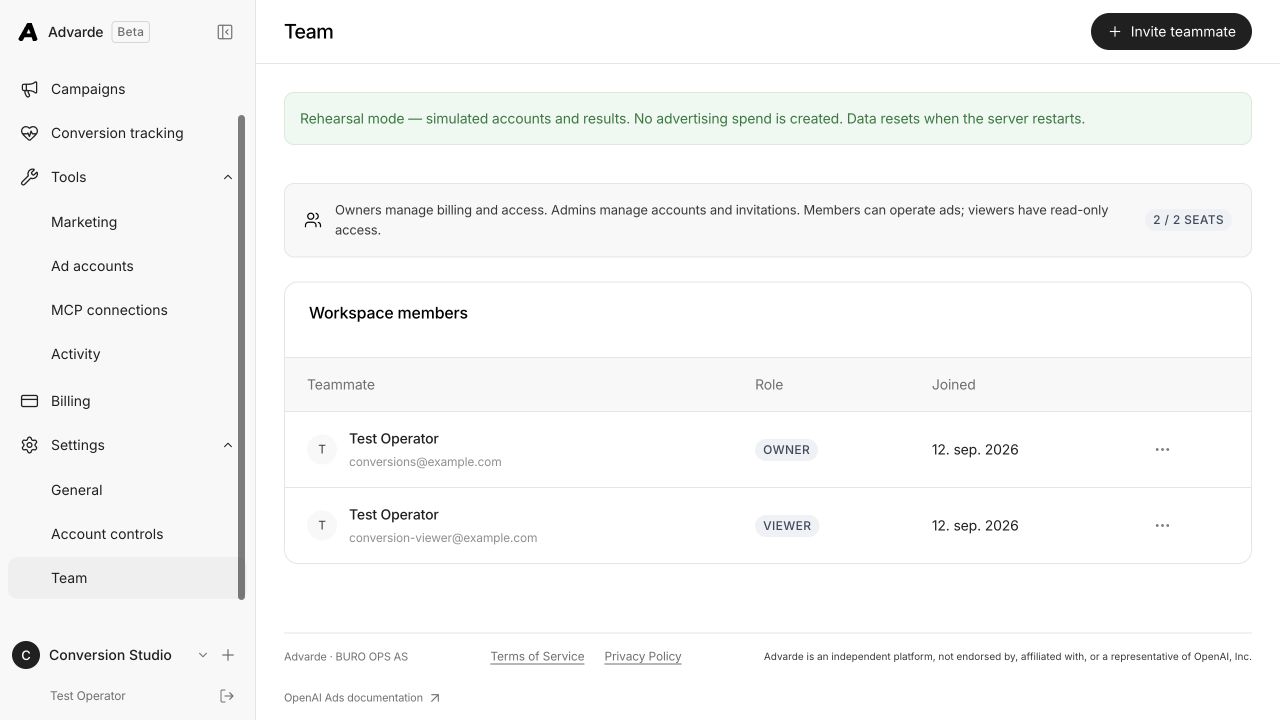
An internal owner can approve budgets and claims while an agency prepares campaigns and investigates delivery. Workspace roles and reviewed changes help make that division visible. Connect the correct client account and confirm it at every consequential step.
Agree which actions require approval and which are covered by an explicitly approved automation policy. A general relationship with an agency is not a clear instruction to increase every budget automatically.
Compare the complete operating cost
Estimate media, software, creative, implementation, agency fees, and internal time. Compare those costs with the quality and speed of the work delivered. An apparently cheaper option can become expensive if measurement is wrong or approvals are repeatedly delayed.
Use a short trial scope with a defined review date. Judge the operating model on accurate setup, clear records, useful learning, and business outcomes rather than the number of ads produced.